
Buying Guide · 8 min read
Browser-Based vs Hardware Lighting Consoles
Hardware consoles offer tactile faders and rock-solid dedicated reliability, but they're expensive and heavy. Browser-based consoles like DMXpressions™ run on any device, cost far less, update instantly and travel in a laptop bag — ideal for education, smaller venues, touring pre-viz and backup, with optional physical control surfaces when you want faders.
The case for hardware
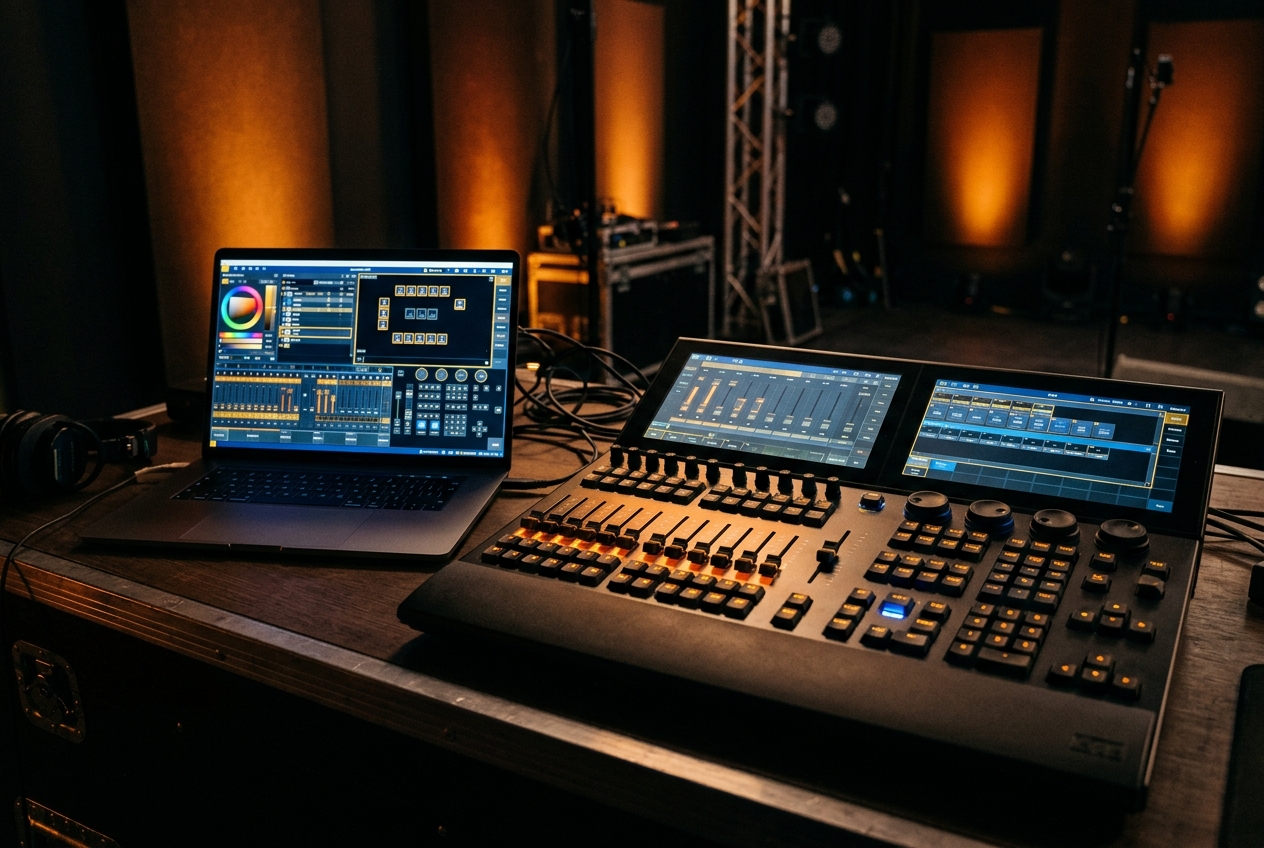
Dedicated lighting desks give you real faders, encoders and buttons — muscle memory that's hard to beat when busking a live show. They're purpose-built appliances, so there's no general-purpose OS to crash and no browser tab to lose. For large-scale touring, a flagship desk with wings is still the standard, and rental houses stock them everywhere.
The case for software / browser
- Cost: a fraction of a hardware desk; no proprietary appliance to buy or insure.
- Portability: your whole console lives on a laptop or tablet you already own.
- Updates: features and fixture profiles arrive continuously, not on a slow firmware cycle.
- Pre-visualization: program and rehearse anywhere with a built-in 3D visualizer.
- Education: every student can have their own console for free in a browser — no lab full of desks required.
- Collaboration: show files are easy to copy, back up and share.
Reliability — the honest answer
A well-managed computer running dedicated software is very reliable, but you should treat it like show gear, not a laptop: disable sleep and notifications, close other apps, run on mains power, and have a backup plan. DMXpressions™ works fully offline once loaded and keeps outputting DMX even if the internet drops, which removes the most common worry.
Tactile control when you want it
The biggest thing software "misses" is physical faders. You can add them back with an inexpensive MIDI or OSC control surface — map faders to playbacks and buttons to bumps, and you get most of the hardware feel at a fraction of the cost.
Who each suits
- Students & educators: software wins on cost and access.
- Bands, worship, small venues, corporate: software covers it comfortably, often with a MIDI surface.
- Large festivals & arena tours: flagship hardware, frequently with software for pre-viz and as tracking backup.
Best of both worlds
You don't have to choose. Many operators run software as the brain and add a control surface for tactile faders; others use a browser console as an affordable backup to a hardware desk via sACN priority. DMXpressions™ supports MIDI, OSC and timecode, so you can build the hybrid setup that fits your workflow and budget.
Related: how many universes you need.